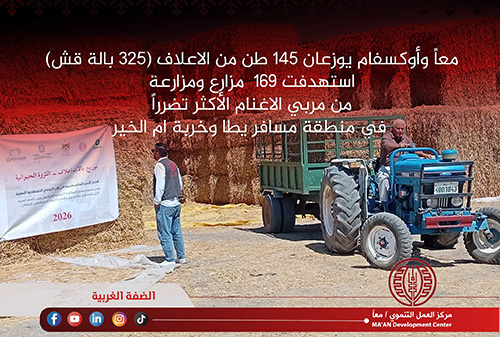
MA’AN Development Center, in partnership with Oxfam and with funding from the Italian Cooperation, distributed 145 tons of animal fodder (325 straw bales) to 169 male and female sheep farmers among the most affected in Masafer Yatta and Khirbet Umm Al-Khair, in the southern West Bank. The distribution was carried out as part of the Emergency Interventions in the Southern West Bank Project.
This intervention was implemented in response to the growing needs of farmers living in marginalized communities that face severe restrictions on movement and access, as well as recurring harassment and violations by Israeli forces and settlers, particularly settler pastoralism, demolitions, and displacement. These challenges have significantly affected their livelihoods and food security.
The distribution covered 11 villages and communities in Masafer Yatta: Maghayir Al-Abeed, Tuba, Isfey Al-Fauqa, Isfey Al-Tahta, Lasifer, Al-Tabban, Al-Fakhit, Al-Majaz, Al-Markaz, Jinba, Al-Halawa, in addition to Khirbet Umm Al-Khair.
The intervention supported 14,589 sheep, as livestock production remains a primary source of livelihood for families in Masafer Yatta and Khirbet Umm Al-Khair. Displacement, demolitions, the seizure of grazing lands, rising fodder prices, economic pressures, and declining household purchasing power have significantly affected livestock farmers’ ability to maintain their herds.
Without timely support, vulnerable households face an increasing risk of reducing the size of their herds, selling productive assets, or accumulating debt. This intervention was designed to mitigate these risks by providing targeted assistance to sheep farmers. It contributed to protecting livestock, reducing livelihood-related risks, strengthening household resilience, and easing the economic burden on families amid the difficult humanitarian conditions affecting the area.
This activity is part of the ongoing efforts of MA’AN Development Center and its partners to support the resilience of the most vulnerable Palestinian communities and strengthen their capacity to cope with escalating humanitarian challenges.