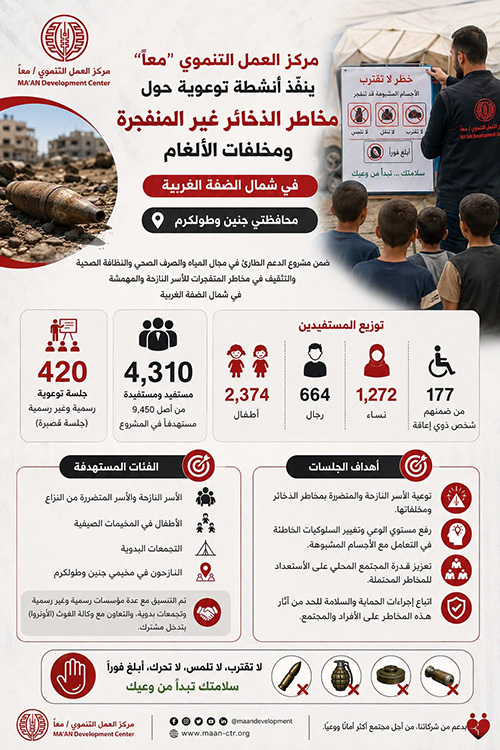
MA’AN Development Center has begun implementing a series of awareness activities and sessions on the risks posed by unexploded ordnance, landmines, and explosive remnants of war. The activities target displaced families and conflict-affected households in the Jenin and Tulkarm governorates in the northern West Bank.
These activities are being implemented under the project “Emergency Support in Water, Sanitation and Hygiene, and Explosive Ordnance Risk Education for Displaced and Marginalized Families in the Northern West Bank.” The project aims to enhance the safety of groups most exposed to these risks and increase their awareness of protection and prevention measures.
To date, the Center has conducted approximately 420 formal and informal awareness sessions, including short sessions that enabled rapid and flexible outreach to different groups and targeted communities. The activities have reached 4,310 women, men, and children out of the project’s overall target of 9,450 people in the Jenin and Tulkarm governorates.
The beneficiaries included 1,272 women, 664 men, and 2,374 children, among them 177 persons with disabilities. During this phase, the activities focused primarily on children participating in summer camps, as they are among the groups most vulnerable to the dangers posed by suspicious objects and unexploded ordnance.
The sessions were implemented in coordination and cooperation with several governmental institutions, civil society organizations, and Bedouin communities. A joint intervention was also carried out with the United Nations Relief and Works Agency for Palestine Refugees in the Near East (UNRWA) to reach families displaced from the Jenin and Tulkarm refugee camps and provide them with the information and guidance necessary to protect their safety.
The sessions aimed to educate displaced and conflict-affected families about the risks of unexploded ordnance and explosive remnants of war, correct unsafe behaviors related to suspicious objects, and emphasize the importance of not approaching, touching, or moving such objects, while immediately reporting them to the relevant authorities.
The activities also focused on strengthening the preparedness of local communities to respond to potential risks, particularly as displaced families begin returning to their places of residence. Participants were encouraged to follow protection and safety procedures in order to reduce injuries and mitigate the humanitarian and social impact of explosive remnants of war.