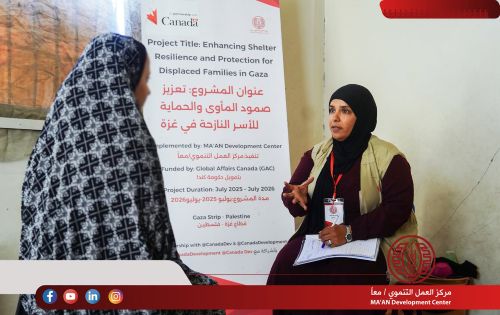
MA’AN Development Center has successfully concluded the implementation of 200 awareness sessions on community protection and Gender-Based Violence (GBV), targeting 200 displaced households from 6 targeted informal shelters and hosting communities across the Gaza Strip as part of the project “Enhancing Shelter Resilience and Protection for Displaced Families in Gaza,” implemented in partnership with Global Affairs Canada (GAC).
These sessions constituted a key component of the project's integrated protection approach, which seeks to ensure that shelter and non-food item (NFI) assistance is accompanied by awareness-raising activities that promote safety, dignity, and access to protection services for the most vulnerable groups, particularly women and girls. The sessions were implemented as part of the project's efforts to raise awareness of GBV-related risks and enhance beneficiaries’ knowledge of prevention and protection measures, reporting and referral mechanisms, and available specialized services. These efforts contribute to strengthening the capacity of displaced families to cope with challenges associated with displacement and inadequate shelter conditions.
The awareness sessions covered a range of key topics, including the concept of Gender-Based Violence and its various forms, factors that increase vulnerability to violence and exploitation in displacement settings and collective shelters, personal safety measures, the importance of privacy within shelters, safe reporting mechanisms for abuse and exploitation, and the psychosocial, legal, and health services available to survivors. During the sessions, informational and awareness materials were distributed, featuring key messages on community protection and GBV prevention. Participants were also introduced to safeguarding and protection policies, as well as the complaints and feedback mechanisms available to beneficiaries.
These activities reflect MA’AN Development Center’s commitment to mainstreaming protection principles across all humanitarian interventions and enhancing displaced families’ access to information and services that safeguard their safety and dignity while strengthening their resilience in the face of the growing humanitarian challenges in the Gaza Strip.