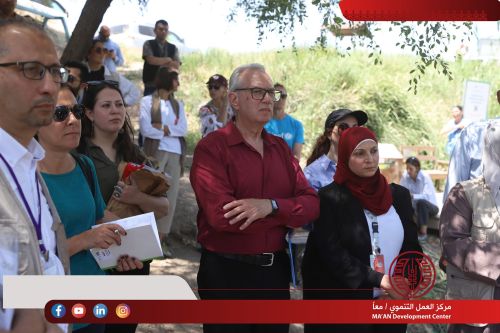
MA’AN Development Center participated in a diplomatic field visit organized by the United Nations Office for the Coordination of Humanitarian Affairs in the occupied Palestinian territory (OCHA) to the Northern Jordan Valley areas.
The visit was attended by the Humanitarian Coordinator for the occupied Palestinian territory, along with representatives from several diplomatic missions and embassies, including those of Austria, the United Kingdom, Sweden, Canada, Germany, Mexico, Poland, Portugal, Russia, and Switzerland, in addition to the European Union, UN agencies, and international humanitarian organizations.
The visit included the communities of Hammamat Al-Maleh, Ein Al-Bayda/Khirbet Al-Deir, and Al-Hadidiya, where the delegation observed the escalating humanitarian challenges faced by Palestinian communities in the Northern Jordan Valley. These challenges include forced displacement, settler attacks, restrictions on access to water resources and grazing and agricultural lands, as well as demolitions and limited access to essential services.
In the Ein Al-Bayda/Khirbet Al-Deir community, Mr. Sami Khader, General Director of MA’AN Development Center, delivered a briefing on the current situation in the Northern Jordan Valley and the humanitarian and development interventions implemented by the center to support the resilience of Palestinian communities, particularly in the sectors of water, food security, education, and health. He also highlighted the major gaps and urgent humanitarian needs facing Bedouin and agricultural communities in the area. Mr. Khader stressed the importance of strengthening the humanitarian response and protecting the Palestinian presence in the Jordan Valley, while commending the role played by diplomatic missions, UN agencies, and OCHA in standing in solidarity with affected communities and conveying their suffering to the international community.
MA’AN Development Center continues its efforts in partnership with various humanitarian and national actors to support the resilience of the most affected Palestinian communities and enhance their access to essential services and dignified livelihoods.