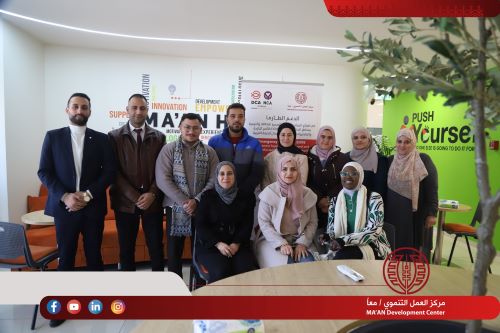
MA'AN Development Center concluded the project “Emergency Water, Sanitation and Hygiene (WASH) Support and Explosive Ordnance Risk Education (EORE) for Displaced and Conflict-Affected Families in the Northern West Bank” by organizing the project’s final meeting. The meeting focused on reviewing project implementation, discussing opportunities and challenges, and identifying key lessons learned to support future interventions in conflict-affected areas.
The meeting was attended by the project team and partners and included a guest speaker, Major Ali Abu Hilal, Head of the Awareness and Training Department at the Palestinian Mine Action Center. The discussion highlighted the changing security situation in the northern West Bank, reviewed key achievements and field challenges, assessed the awareness approaches used and their relevance to the target groups, and presented success stories that demonstrated the project’s positive impact on community awareness and behavior.
The project was implemented in partnership with DCA/NCA and funded by the Augustinus Foundation. It targeted displaced and conflict-affected families in the Jenin and Tulkarm governorates, their surrounding areas, and nearby villages. The project focused on improving access to water and sanitation services, raising awareness of explosive ordnance risks (EORE), promoting civilian preparedness and protection in times of conflict (CPP), and supporting safe return awareness for displaced families.
Project activities included direct awareness sessions for local communities, reaching more than 19,000 people, including 30% women, 47% children, and 4.1% persons with disabilities, with special attention to the inclusion of the most vulnerable groups. Specialized sessions were also conducted for farmers and scrap metal collectors, who face higher risks due to the nature of their work, as well as school children, who are particularly vulnerable because of their curiosity toward unfamiliar objects.
Overall, the project aimed to increase community awareness of explosive hazards, encourage safe behaviors, reduce accidents and injuries, and contribute to saving lives and strengthening community safety, while also supporting the resilience of displaced and affected families under challenging humanitarian conditions.