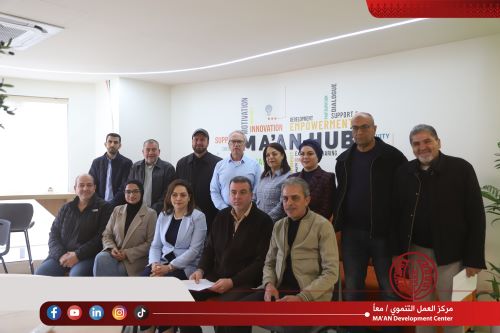
MA’AN Development Center signs MoUs with village councils to strengthen community resilience in the West Bank and support sustainable development projects, in partnership with Oxfam and Miftah, funded by BMZ.
MA’AN Development Center, in partnership with Oxfam and Miftah Foundation, and funded by the German Federal Ministry for Economic Cooperation and Development (BMZ) under the Transitional Development Assistance (TDA) program, held a signing session for memorandums of understanding (MoUs) with representatives of the village councils of Al-Mudayya, Badrus, Shibteen, Qabya, and the municipality of Na’lin. This was part of the project “Building Resilience in West Bank Communities to Turn Current Shocks into a Sustainable Future.”
This activity is part of the project’s efforts to unify roles, strengthen cooperation, and support local communities in building resilience and recovering from current crises.
The MoUs aim to enhance collaboration and coordination with local authorities and community committees, and to establish a participatory approach that ensures all members of the local community are involved in planning and implementing development activities. These activities include temporary employment, income-generating projects, improved access to basic services such as water and sanitation, and empowering local councils and committees to play an active role in planning, implementation, and follow-up. This approach also helps create sustainable environments, reduce the effects of climate change, strengthen social cohesion, and increase local readiness.
The MoUs clearly define the roles and responsibilities of all parties, organize coordination, monitoring, and evaluation mechanisms, and ensure that activities are carried out efficiently, transparently, and fairly, while making project outcomes sustainable.
They also emphasize the importance of continuing institutional work, strengthening the role of local committees, and supporting their involvement in project interventions. This aligns with the project’s goal of building community systems that can respond to shocks and turn challenges into opportunities for recovery and sustainable development.
This session is part of a series of activities aimed at building strong partnerships with local communities and promoting sustainable development based on participation and shared responsibility.